The NIHStroke Scale in Right MCA Stroke Assessment
Aug 18
2 min read
Introduction:
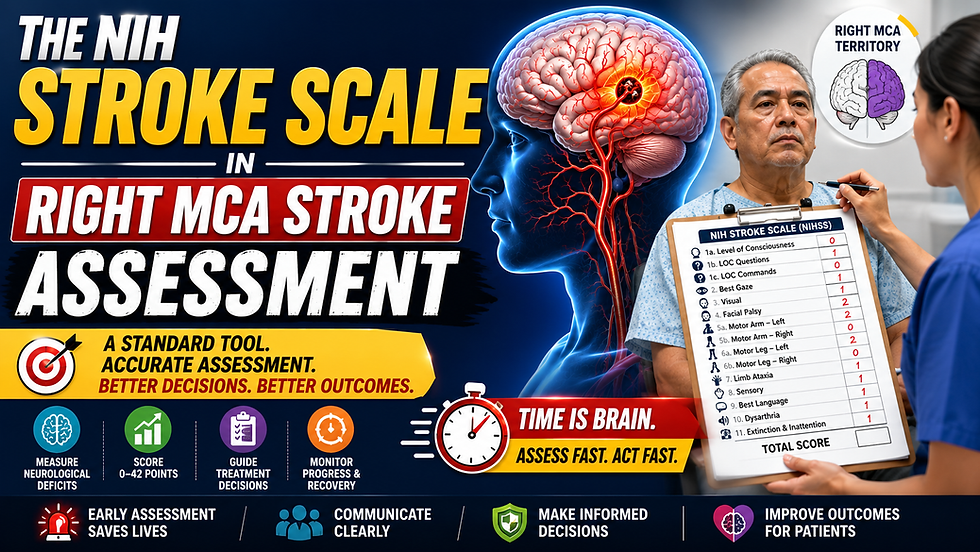
The National Institutes of Health Stroke Scale (NIHSS) is a standardized neurological assessment used to measure the severity of stroke-related deficits. It helps healthcare professionals quickly document neurological impairment, communicate a patient’s condition, monitor changes over time, and support acute treatment decisions. In a right Middle Cerebral Artery (MCA) stroke, the NIHSS can help quantify problems such as left-sided weakness, sensory loss, visual impairment, language difficulties, and neglect. Current American Heart Association/American Stroke Association guidance identifies the NIHSS as an important tool for assessing stroke severity and clinical status.
What Does the NIHSS Measure:
The NIHSS examines several neurological functions, including level of consciousness, orientation, ability to follow commands, eye movements, visual fields, facial movement, arm and leg strength, coordination, sensation, language, speech clarity, and attention or neglect. Each component receives a specific score, producing a total that reflects the overall neurological deficit. The official NIHSS instructions emphasize recording what the patient actually demonstrates during the examination and administering the items consistently.
Why It Matters in Right MCA Stroke:
Right MCA strokes often affect the left side of the body and may cause visual-spatial problems or left-sided neglect. A patient may have substantial functional impairment even when certain NIHSS components produce relatively low scores. The 2026 stroke guideline notes that NIHSS is valuable for severity assessment and treatment decisions, but the score should not be used alone to determine whether a deficit is disabling. Functional abilities such as walking and swallowing must also be considered.
NIHSS and Emergency Treatment:
During the initial stroke evaluation, the NIHSS can provide rapid objective information for the stroke team. Baseline scoring can assist with identifying the extent of neurological injury and documenting changes after treatment. It can also contribute to decisions concerning reperfusion therapies, although eligibility for thrombolysis or endovascular treatment depends on the complete clinical assessment, brain imaging, vessel imaging, timing, and other factors—not simply one NIHSS number.
Monitoring Recovery:
Repeating the NIHSS can help clinicians determine whether neurological function is improving, remaining stable, or worsening. Changes in the score may provide useful information during the early hospital period and can contribute to outcome prediction. However, rehabilitation progress should also include practical measures of mobility, communication, independence, cognition, and daily activities because the NIHSS does not capture every aspect of disability.
Conclusion:
The NIH Stroke Scale is an important standardized tool for assessing and monitoring patients with right MCA stroke. By measuring multiple neurological functions, it provides a common language for stroke teams and supports rapid, consistent clinical evaluation. Nevertheless, NIHSS results should always be interpreted alongside imaging, examination findings, functional status, and the patient’s individual circumstances. Early assessment and repeated monitoring can help guide care and provide a clearer picture of neurological recovery.
(The domain www.dubaitelemedicine.com is for sale. Please contact us at www.kneetie.com#KneeTie #Stroke #youtube/kneetiegorungo #DubaiTelemedicine)


Comments